
Manufacturing Website Development: The Complete Guide for USA Manufacturers in 2026
Let me tell you a quick story. A few years ago, a small machine shop owner in Ohio — let’s call him Dave — was running a solid business. His shop had been around for 22 years. Great quality. Good reputation in the local area. But his website? It looked like it was built in 2009 and never touched again. No mobile version. No product details. Just a phone number and a blurry photo of his shop floor.
Dave kept losing bids to competitors he knew were not as good as him. When he finally asked one of his lost prospects why they went with someone else, the answer was simple: “Your website didn’t look like you were still in business.”
That hit hard. And honestly, if you are running a manufacturing business in the USA right now, that story might feel familiar. This blog is for you. We are going to walk through everything you need to know about manufacturing website development — in plain, simple language. No tech jargon. No complicated words. Just real, useful information that helps you understand what you need and why.
1. Manufacturing Website Design — First Impressions Are Everything
Why Your Website Look Matters More Than You Think
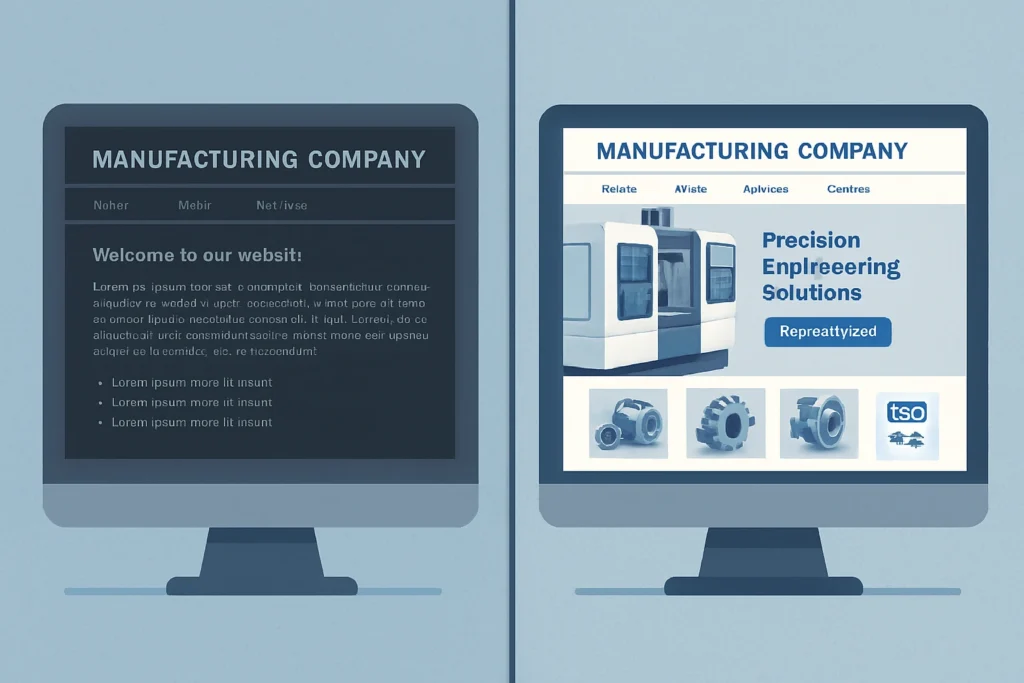
Think about the last time you judged a restaurant by its front door. You didn’t even go inside. You just looked and decided. That is exactly what happens with your manufacturing website. About 40% of industrial buyers make their buying decision based on how your website looks and feels. Nearly half your future customers are deciding before they ever call you or email you.
Good manufacturing website design is not about making something fancy or flashy. It is about making something clean, easy to use, and trustworthy. When someone visits your site, they want to find your products fast. They want to see your certifications. They want to know your company has been around for a while and knows what it is doing.
Design Elements That Actually Convert Industrial Buyers
A well-designed manufacturing website needs clear product categories, simple navigation menus, and a professional look that matches your industry. If you sell heavy equipment, your website should feel serious and solid — not like a candy shop. Color choices, fonts, and photos all play a role. Real facility photos work much better than generic stock images. Buyers want to see your actual shop floor, your team, and your equipment.
Mobile Design Is Not Optional Anymore
One thing many manufacturers forget is that your design also needs to look good on a phone. Field engineers and procurement managers are checking websites from job sites every single day. If your site is hard to use on mobile, you are losing those buyers before they even read a word of your content.
2. Industrial Web Development — Building Something That Actually Works
A Website Is a System, not a Brochure
Here is where a lot of manufacturers get tripped up. They think building a website is the same as printing a brochure. It is not. Industrial web development is really about building a system — one that works for your sales team, your buyers, and your business operations all at the same time.
A good industrial website is built on solid code. It loads fast — we are talking under 3 seconds. It is secure, which matters a lot when you are dealing with B2B clients who send sensitive project files. It connects to your CRM so leads do not fall through the cracks. And it is easy for your marketing team to update without calling a developer every time.
The Real Cost of Cheap Web Development
One agency owner I spoke to put it this way: “We see manufacturers spend $80,000 on a beautiful website that crashes after a software update, because it was built with 40 different plugins all stacked on top of each other. Six months later, they are rebuilding from scratch.” That is the reality of cheap, shortcut web development.
Engineering-First Development: The Smart Way to Build
For manufacturers in the USA, the smart move is engineering-first development. That means building custom code for the things that matter most — like your product catalog, your RFQ form, and your document downloads — instead of relying on third-party plugins that may stop working next year. It costs a little more upfront but saves you a lot of headaches and money over time.
3. Website Development for Manufacturers — What Makes It Different
Your Buyers Are Not Regular Online Shoppers
A general web developer can build you a nice-looking website. But website development for manufacturers is a different thing entirely. Your buyers are not regular shoppers. They are engineers, procurement managers, and operations teams. They need technical data. They need CAD drawings. They need spec sheets they can download in seconds.
Think about it this way. If you sell industrial pumps, your website needs to show the exact size, pressure rating, material, and flow rate for every single model. A buyer who is specifying a pump for a water treatment plant does not have time to call your sales rep just to get a basic spec. They need that information on your website — right now, easy to find, easy to download.
RFQ Forms: The Most Important Feature on Your Site
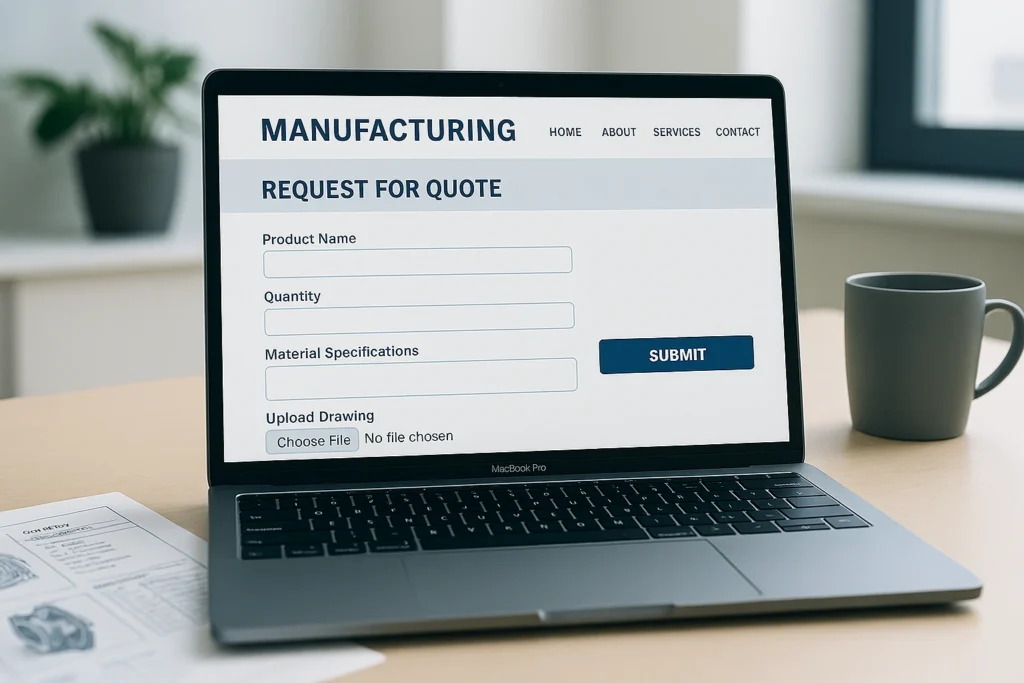
Manufacturing websites also need Request for Quote (RFQ) systems. Most of your products are not bought online like a pair of shoes. The buyer needs to ask for a custom price, often based on quantity, materials, or special requirements. A good RFQ form lets them send you everything you need in one go — product selection, quantity, specifications, and even a drawing file if needed.
Real Results: What Happens When You Get This Right
One manufacturer in Texas shared that after adding a proper RFQ system to their website, their qualified leads went up by over 300% in less than a year. The buyers were already out there searching. The website just gave them a way to take action.
4. Manufacturing Company Website — Building Trust Before the First Phone Call

Two-Thirds of the Buying Process Happens Before Anyone Calls You
Here is something that most people do not think about. When a big company is looking for a new manufacturing partner, they do a lot of research before they ever pick up the phone. They visit your website, read your about page, look at your certifications, check out your past work, and form an opinion — all before they contact you.
This means your manufacturing company website needs to answer trust questions automatically. Are you ISO certified? Show it clearly. Have you worked with well-known brands? Put their logos on your homepage. Have you solved a difficult manufacturing problem for a client? Write a case study about it.
Real Photos Beat Stock Images Every Single Time
Real photos of your facility are worth more than any marketing text. When a buyer sees your clean, organized shop floor, your modern CNC machines, or your quality control area, they feel confident. They think — these people know what they are doing. That feeling of confidence is what turns a website visitor into a sales call.
Your About Page Is More Powerful Than You Realize
Your About page also matters more than you think. A short paragraph about your company history, your team, and what you stand for goes a long way. People buy from people. When they can see faces and read a real story, the whole relationship starts on a more personal level — even in a B2B world.
5. B2B Manufacturing Website — Designed for the Way Business Buyers Actually Buy
One Website, Three Very Different Visitors
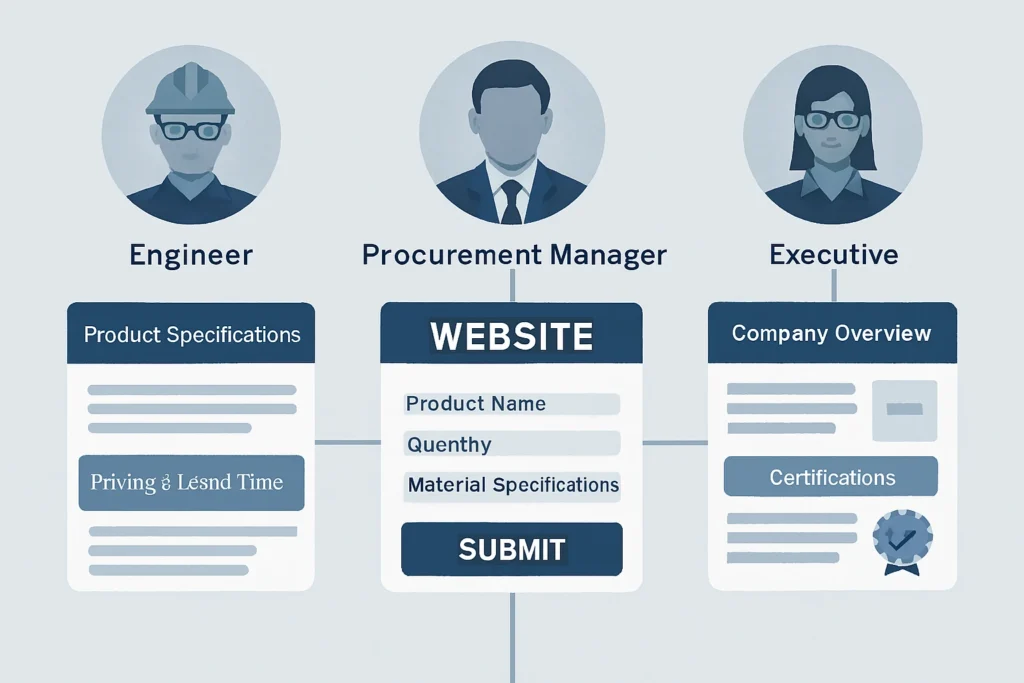
Selling to another business is completely different from selling to a regular consumer. A B2B manufacturing website has to serve multiple people at the same company — the engineer who checks specs, the procurement manager who checks pricing, and the executive who checks overall company credibility. One website, three very different visitors.
The buying process in manufacturing can take anywhere from a few weeks to over a year. During that time, your website is working 24 hours a day answering questions, building confidence, and keeping your company in the buyer’s mind. This is why every section of your site needs to be useful and not just pretty.
What Each Buyer Type Needs From Your Website
For the engineer — give them filterable product catalogs, comparison tools, and downloadable data sheets. For the procurement manager — show lead times, volume capabilities, and a clear way to request pricing. For the executive — show your company history, your major clients, your certifications, and your case studies.
Customer-Specific Pricing: A Feature Most Manufacturers Overlook
One important feature for B2B manufacturing websites is customer-specific pricing. Many manufacturers have different price agreements with different customers. A good website can show a logged-in distributor their special pricing while showing a new visitor a “request a quote” button instead. This keeps relationships professional and protects your pricing strategy.
6. Custom Manufacturing Website — Why One-Size-Fits-All Templates Fail
Templates Are Built for Everyone — Which Means They Work for No One
You would not use a generic brochure template to sell a 500-ton hydraulic press. So why would you use a generic website template for your manufacturing business? A custom manufacturing website is built around your specific products, your specific buyers, and your specific sales process.
Template websites have real problems. They are slow because they are loaded with features you do not need. They look like everyone else’s website. And they cannot handle the complex product structures that most manufacturers have. When you sell 300 SKUs with 12 variations each, a standard template just falls apart.
Custom Navigation Built Around How Your Buyers Search
A custom-built website, on the other hand, is structured exactly around how your buyers search. If your customers always start by choosing a product family and then narrowing down by material and size, your website navigation is built that way. If they search by part number, your search bar is built to handle that. Every click is designed with purpose.
ERP and CRM Integration: Where the Real Value Lives
Custom websites also integrate with your existing business systems — your ERP for inventory data, your CRM for lead tracking, and your accounting software for pricing. When a buyer requests a quote on your site, it shows up automatically in your sales team’s CRM. No manual data entry. No missed leads. That is the real value of custom development.
7. Website for Manufacturing Business — SEO, Speed, and Getting Found on Google
If You Are Not on Page One of Google, You Are Invisible
You can have the most beautiful manufacturing website in the world, but if nobody can find it on Google, it is basically invisible. More than 90% of B2B buyers start their search online. And search brings over 40% of traffic to industrial websites. If your competitors are on page one of Google and you are not, they are getting the leads that should be yours.
How SEO Works for Manufacturing Websites
SEO for a manufacturing business website is about making sure Google understands what you do and who you serve. That means using the right keywords in your product pages, your headings, your titles, and your descriptions. It also means making your site fast — Google gives better rankings to websites that load quickly. A site that takes 6 seconds to load loses buyers and rankings at the same time.
Local SEO: Getting Found in Your Own Backyard First
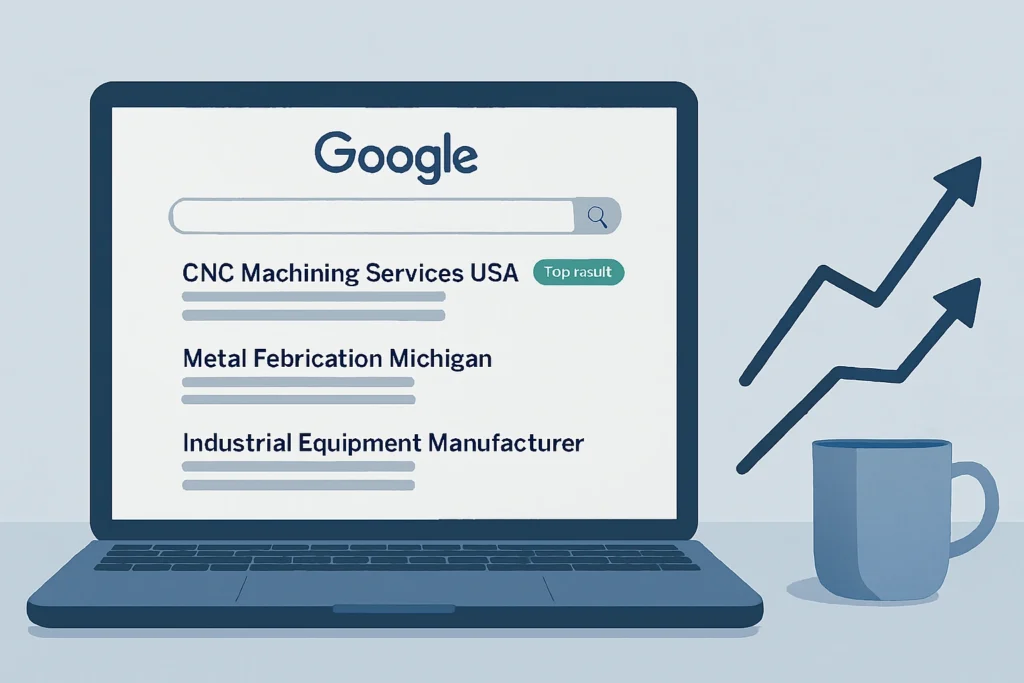
Local SEO also matters a lot for USA manufacturers. If you are a metal fabricator in Michigan, you want to show up when someone in Michigan searches for metal fabrication services. Setting up your Google Business Profile, getting listed in industrial directories like Thomasnet, and having your address clearly on your site all help with local search visibility.
Write Real Content — Google Rewards It
One thing I always tell manufacturers — write real content on your product pages. Do not just copy-paste the spec sheet from your supplier. Write a short paragraph about who uses this product, what problems it solves, and why your version is worth buying. Google rewards original, useful content. And buyers appreciate it too.
8. Manufacturing Website Development — Costs, Timelines, and What to Expect
Let’s Talk Real Numbers
Let’s talk money — because that is always the big question. How much does manufacturing website development actually cost in the USA? The honest answer is: it depends on how complex your needs are. But here are some real numbers that can help you budget.
A basic manufacturing website — maybe 10 to 20 pages, no product catalog, no special integrations — usually runs between $15,000 and $30,000. A mid-level site with a product catalog, RFQ forms, and basic SEO setup typically costs between $30,000 and $60,000. If you need a full e-commerce setup, ERP integration, and a large product catalog, you are looking at $60,000 to $150,000 or more.
The ROI Is Real — Here Is Proof
Now, before those numbers scare you — think about the return. If your new website helps you close just two or three additional deals per year, it almost certainly pays for itself. One manufacturer in the Midwest shared that their website investment of $55,000 generated over $400,000 in new contracts in the first 18 months. The website never sleeps, never takes a sick day, and never forgets to follow up.
How Long Will It Take? Realistic Timelines
Timeline-wise, expect 10 to 26 weeks depending on complexity. Do not let anyone promise you a full manufacturing website in two weeks. Good development takes time — planning, design, building, testing, and launch. Rushing any step creates problems you will deal with for years.
Final Thoughts — Your Website Is Your Best Salesperson
Dave’s Story — How It Ended
Going back to Dave from Ohio — after he finally invested in a proper manufacturing website, things changed. Within 6 months, he was getting quote requests from companies three states away. Buyers who had never heard of him were finding him on Google and reaching out. His sales team spent less time explaining basic specs and more time closing deals.
That is what a well-built manufacturing website does. It works for you every single day. It answers questions at 2am when your sales team is sleeping. It builds trust with buyers who have never met you. It shows the world what your company is capable of.
What You Should Do Next
Whether you are a small CNC shop in Ohio, a metal fabricator in Texas, or a large industrial equipment manufacturer in California — your website matters. It is not just a digital brochure. Done right, it is your most powerful sales and marketing tool.
If you are ready to take your manufacturing website to the next level, start by listing what your buyers need most. Think about what questions they ask before they call you. Build your website around those answers. Find a web development partner who understands manufacturing — not just web design. And invest in something that will still be working hard for your business five years from now.
Your manufacturing business deserves a website that actually works as hard as you do.
or u can visit our website zyvex.co for further discussion for your website.

1 Comment
Amazing helpful